Sunday, December 19, 2010

From The Lion and the Sun

Balakirev glanced sideways at Conte. They kept walking. The Rathaus came into view, its four spires and soaring campanile lit by floodlights, the square in front filled with booths and milling people. The whole effect like a combination outdoor sale, flea market, and county fair all garbed in Christmas decorations.

For a while Conte and Balakirev just strolled about looking at the cured meats and Austrian cheeses in one booth, and the hand-painted eggs in another. A group of young men went by holding large cups of beer, laughing and singing what sounded like soccer chants, “Wir sind Zecken, asoziale Zecken, wir leben unter Brücken oder in der Bahnhofsmission!”

The two men followed the aroma of meat grilling and stopped at a booth selling bratwurst on Kaiser rolls. They smothered their sandwiches in hot Austrian mustard and walked on, wolfing them down and looking for someplace to buy beer.

Conte finished his bratwurst and walked to a trashcan to throw out the paper tray. A young girl, perhaps 16 or 17, maybe older, it was hard to tell, was digging through the trash. She was wearing what had once been a white evening gown, and had a dirty, cream-colored scarf wrapped around her neck and shoulders. The girl came out with a half eaten piece of roll, ate it and licked the mustard from the paper in which it had been wrapped. Her eyes darted here and there, and then came to rest on Conte. She pointed at him, smiled and put her index finger to her pursed lips.

Balakirev had stopped at a booth selling gluwein. He held the hot, steaming cup of spiced wine in his hands and blew on it. He looked up as Conte came over to him. “Something to warm us up” he said, pointing to a cup he’d purchased for Conte.

They walked across the front of the Rathaus and turned down Lichtenfelsgasse, sipping their gluwein as they went. Conte asked Balakirev whether Russia was going ahead with the sale of laser isotope separation technology to Iranian laboratories.
“It’s a matter under discussion,” he said, without elaboration.
Conte stopped walking and waited until Balakirev turned and looked at him. “I’ll say it again; that technology could be used for nuclear weapons development purposes.”
“We discuss these things, Daniel, and sometimes certain incentives are offered, oil for example, then we discuss them again, and finally we offer something else.”
"You're going to repair Bushehr?"
Balakirev smiled.
They started walking again.
“What condition is Bushehr in now?”

Bushehr was a nuclear power plant that Iran had started building in 1975. Iraq bombed the plant during the 1980-88 war with Iran. Intelligence suggested that Iran was negotiating with the Russians to repair and finish the plant after the Germans had backed out of the deal.

“Bushehr isn’t too bad. We can fix it,” Balakirev answered.
“Are you going to?”
“What is the expression so popular in the Arab World? Inshalla."

Pond off the 10th Fairway

Monday, December 13, 2010

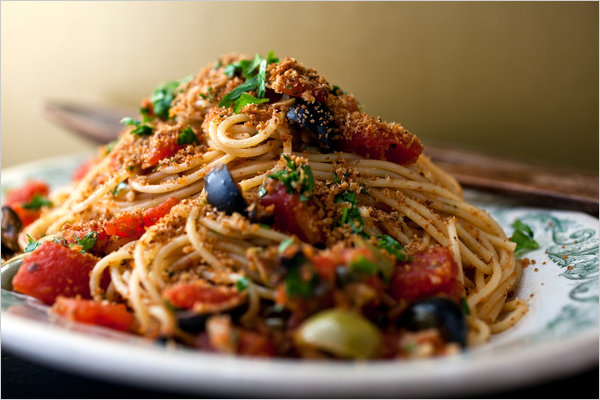
Pasta With Tomatoes, Capers, Olives and Breadcrumbs

By MARTHA ROSE SHULMAN

Published: December 6, 2010 in the New York Times


Bread crumbs, crisped in olive oil with garlic, make a flavorful addition to just about any pasta. Make your own bread crumbs if you’ve got bread that’s drying out, and keep them in the freezer.
3 tablespoons extra virgin olive oil
3 garlic cloves, 2 sliced, 1 minced
1/2 cup fresh bread crumbs
1/4 teaspoon hot red pepper flakes
1 14-ounce can chopped tomatoes, with juice
2 tablespoons capers, rinsed and coarsely chopped
1/2 cup green or black olives, pitted and coarsely chopped (2 ounces)
Salt and freshly ground pepper
3/4 pound spaghetti, preferably a good whole-wheat brand
1/4 cup chopped fresh parsley (optional)
1/4 cup freshly grated Parmesan (optional)
1. Begin heating a large pot of water for the pasta. Meanwhile, combine 2 tablespoons of the olive oil and the sliced garlic over medium-low heat in a medium saucepan or skillet. Cook, stirring often, until the garlic turns golden, about two minutes. Do not let it take on any more color than this. Remove the garlic slices with a slotted spoon and discard, then add the bread crumbs to the pan. Turn the heat to medium, and cook, stirring, until the bread crumbs are crisp. Remove from the heat, and set aside.
2. Return the pan to medium heat, and add the remaining olive oil, the red pepper flakes and the minced garlic. Cook for about 30 seconds until the garlic smells fragrant, and add the tomatoes, capers and olives. Bring to a simmer, and simmer until the tomatoes have cooked down and smell fragrant, 15 to 20 minutes. Season with salt and pepper.
3. When the water comes to a boil, salt generously and add the spaghetti. Cook al dente, following the cooking recommendations on the package but checking about a minute before the suggested time. Drain, and toss with the tomato sauce. Sprinkle the bread crumbs and parsley on top, toss again briefly and serve, passing the Parmesan at the table.
Yield: Serves four.
Advance preparation: You can make the recipe through Step 2 several hours before cooking the pasta. The bread crumbs will keep for a couple of weeks in the freezer. Reheat and crisp in a dry pan over medium heat. The tomato sauce will keep for a few days in the refrigerator.
Nutritional information per serving: 450 calories; 14 grams fat; 2 grams saturated fat; 0 milligrams cholesterol; 70 grams carbohydrates; 10 grams dietary fiber; 718 milligrams sodium (does not include salt added during preparation); 12 grams protein.

Thursday, December 9, 2010

Love in Retrospect


He stood looking out across the Stadt Park; back in Vienna after so many years. He remembered it had been about this time of year. The skies were overcast, and a fine mist meandered through the park. The damp cold seemed to find ways to seep through his sweats as he jogged along the wet path, hop-scotching puddles. Russian crows were strutting through the carpet of leaves bordering the footpath. They flew to bare branches complaining in loud cacaws at his intrusion. He had stopped, hands on knees, catching his breath. He couldn’t stop thinking of her despite trying to run himself into unconsciousness.
Back at the K&K Hotel, he'd showered and dressed. He was early. She’d invited him to dinner . “Christmas dinner,” she’d said, although it wasn’t yet Christmas, and they wouldn’t spend Christmas together, ever, as it turned out. He'd paced the room for as long as he could stand it, and then left for her flat on Operngasse.
Garlands of lights were being strung across Kartnerstrasse. A tree had already been placed in the middle of the broad walk. On the Graben, workmen were struggling to erect a set of huge stars. The up-scale stores were setting up their Christmas decorations. He’d be leaving Vienna for Istanbul first thing in the morning. He'd miss the displays, the Kris Kringle Markt, and the caroling. And although he didn't know it at the time, he'd never again see the only woman he’d ever truly loved.

Friday, December 3, 2010

Monday, November 29, 2010

What's "Real" in the Story, Double Blind?

In my short story, Double Blind, the father of Jason, the boy afflicted with non-Hodgkin lymphoma, is a senior optomechanical engineer from CALTECH, who is fascinated with something called Bell’s Theorem, which is described in the story as, "a highly esoteric mathematical proof showing that if the statistical predictions of quantum theory are correct, then some of mankind’s commonsense ideas about the world are profoundly mistaken."

In our perception of physical reality, action on one particle of a widely separated entangled pair cannot instantaneously alter the physical state of the faraway partner particle. This “locality” is a condition requiring the value assigned to an operator associated with an individual particle or constituent of a composite system to be independent of what is measured on any other particle or constituent. More simply, locality is the principle that an event which happens at one place can not instantaneously affect an event someplace else. But John S. Bell, a staff member of the European Organization for Nuclear Research (CERN) proved otherwise in a ground-breaking paper published in 1964.

Several years after quantum mechanics had been developed, Einstein, Poldolsky, and Rosen published a paper showing that under certain circumstances quantum mechanics predicted the breakdown of locality (the 1935 paper has become known by the initials of its authors, EPR). Bell later proved this to be the case and locality ceased to exist -- what happens somewhere in space-time can instantaneously affect what happens somewhere else in space time. Einstein called this “spooky action at a distance,” and indeed, it is.

So Bell's Theorem is real. Why did I include it in the story? Because something happened to Jason during his wanderings in the shrub stepp that cannot be explained within our common understanding of reality. We just can't accept the idea that Jason's encounter in the shrub steppe could be the result of "entangled particles," one effecting the other simultaneously in space-time. But there's clearly a lot about "reality" that we know very little about.

Sunday, November 21, 2010

Jabberwock, by Lewis Carroll

’Twas brillig, and the slithy toves
Did gyre and gimble in the wabe;
All mimsy were the borogoves,
And the mome raths outgrabe.

“Beware the Jabberwock, my son!
The jaws that bite, the claws that catch!
Beware the Jubjub bird, and shun
The frumious Bandersnatch!”

He took his vorpal sword in hand:
Long time the manxome foe he sought—
So rested he by the Tumtum tree,
And stood awhile in thought.

And as in uffish thought he stood,
The Jabberwock, with eyes of flame,
Came whiffling through the tulgey wood,
And burbled as it came!

One, two! One, two! and through and through
The vorpal blade went snicker-snack!
He left it dead, and with its head
He went galumphing back.

“And hast thou slain the Jabberwock?
Come to my arms, my beamish boy!
O frabjous day! Callooh! Callay!”
He chortled in his joy.

’Twas brillig, and the slithy toves
Did gyre and gimble in the wabe;
All mimsy were the borogoves,
And the mome raths outgrabe.